
The short answer
Define what good communication means in real situations. Agree on how to raise a concern, who responds, and what happens after the conversation.
“We need to communicate better” is often true. It is also easy to agree with and difficult to use. Does it mean speaking more during a drill, being clearer about roles, addressing tension between teammates, or responding when someone raises a concern?
A useful team conversation moves from the slogan to the situation. People need to know what to do, who to speak to, and what kind of response they can expect. Otherwise silence and guessing become the unofficial system.
Choose a situation, not a slogan.
Start with one recurring friction point. Perhaps athletes are unclear about schedule changes, feedback gets personal, or concerns are discussed in side conversations but never brought to the people who can address them.
Ask what currently happens in that situation. Let the team describe the sequence before proposing a solution. A coach may think the problem is a lack of willingness to speak, while athletes may think there is no useful time or place to do it. Those are different problems.
Make the expected exchange concrete.
A standard such as “be respectful” needs an example. Discuss what respectful disagreement sounds like, how someone can ask for clarification, and how the listener should respond. Include the adults in the expectation, not only the athletes.
Try “Describe the action, say its impact, and ask a question” as a discussion prompt. For example: “When the change came after warm-up, I didn’t know my role. How should I check that next time?” This is a suggested practice, not a proven formula.
A few ways to start
- “Where should a concern be raised?”
- “Who will respond, and when?”
- “How do we disagree without attacking the person?”
Speaking up is only half the conversation.
If you ask for honesty and then dismiss the first uncomfortable answer, the invitation loses meaning. You can listen to a concern without agreeing with it. Acknowledge the question, explain what you can explain, and name any next step.
If you need time, say when you will come back to it. If the answer cannot be shared because of privacy, state the boundary rather than acting as though the question was unreasonable. People can work with limits more easily when the limits are made clear.
Research supports paying attention, not making promises.
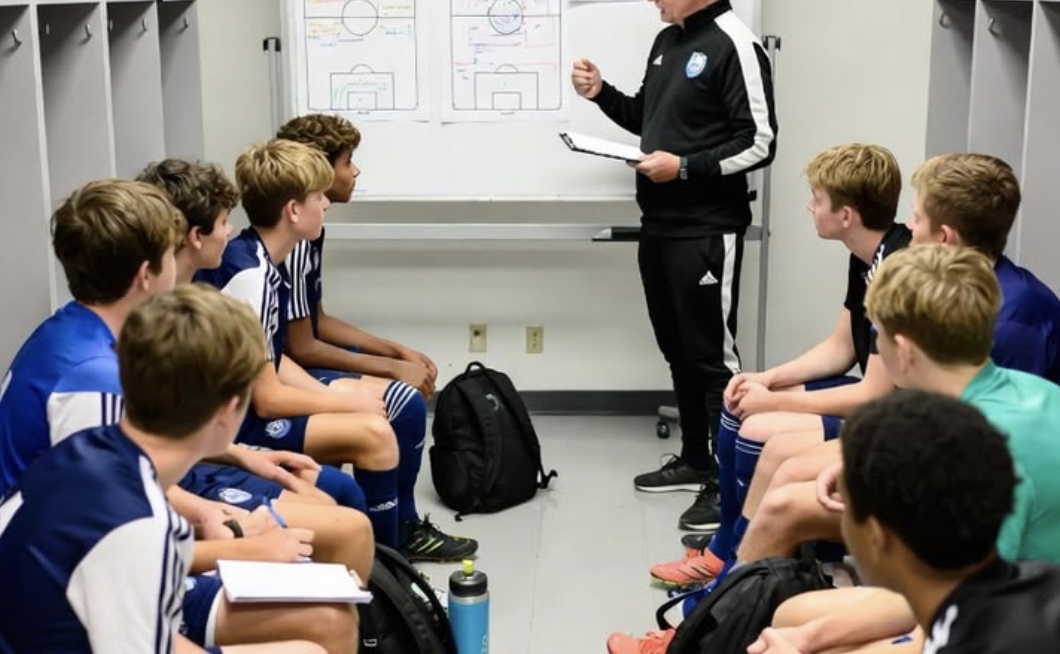
A 2016 study surveyed 139 youth soccer players from 13 teams and examined team-member communication and perceived cohesion. It found associations between communication dimensions and perceived task and social cohesion.
That is observational evidence from a particular setting. It cannot establish that a new communication routine causes cohesion, wins or better well-being. The practical takeaway is narrower: communication is worth examining as part of how athletes experience the team, rather than treating it as background noise.
Practice a disagreement before the stakes are high.
Use an ordinary hypothetical situation: a teammate missed a shared responsibility, or two players understood an instruction differently. Ask the group to describe a respectful opening line and a useful response. Keep real people’s sensitive situations out of the exercise.
Notice whether everyone gets to participate or whether the most confident voices write the whole standard. A quiet athlete may have a useful perspective without wanting to share it in front of the full group. Offer another way to contribute without promising confidentiality you cannot provide.
Return to the agreement after you use it.
At the next check-in, ask whether the agreed approach was usable. Did people know where to go? Did someone respond? Was the next step clear? Change what was impractical rather than assuming the team failed because it did not care.
Keep the agreement small enough to remember. One workable standard is more useful than a long list nobody revisits. The purpose is not to eliminate tension. It is to give the team a better way to handle tension when it appears.
Sources + context
The articles draw on the sources below. Conversation prompts are suggested exercises, not clinically validated methods or promises of performance outcomes.
- Team Member Communication and Perceived Cohesion in Youth Soccer (2016) ↗
Survey of 139 players across 13 youth soccer teams. Associations with perceived cohesion do not prove causation.
- 25 years of relationship research in sport: the coach-athlete relationship and the 3+1Cs Model (2025) ↗
A research overview of closeness, commitment, complementarity and co-orientation; not a test of the exercises suggested here.
C & C provides education, workshops and consulting—not therapy, diagnosis or medical treatment. Individual care belongs with appropriately licensed professionals.
A conversation worth having in your own context?
Tell Cristo what is happening. We can explore the right educational or consulting next step without asking you to have the solution first.
Talk With Cristo